February 6, 2026

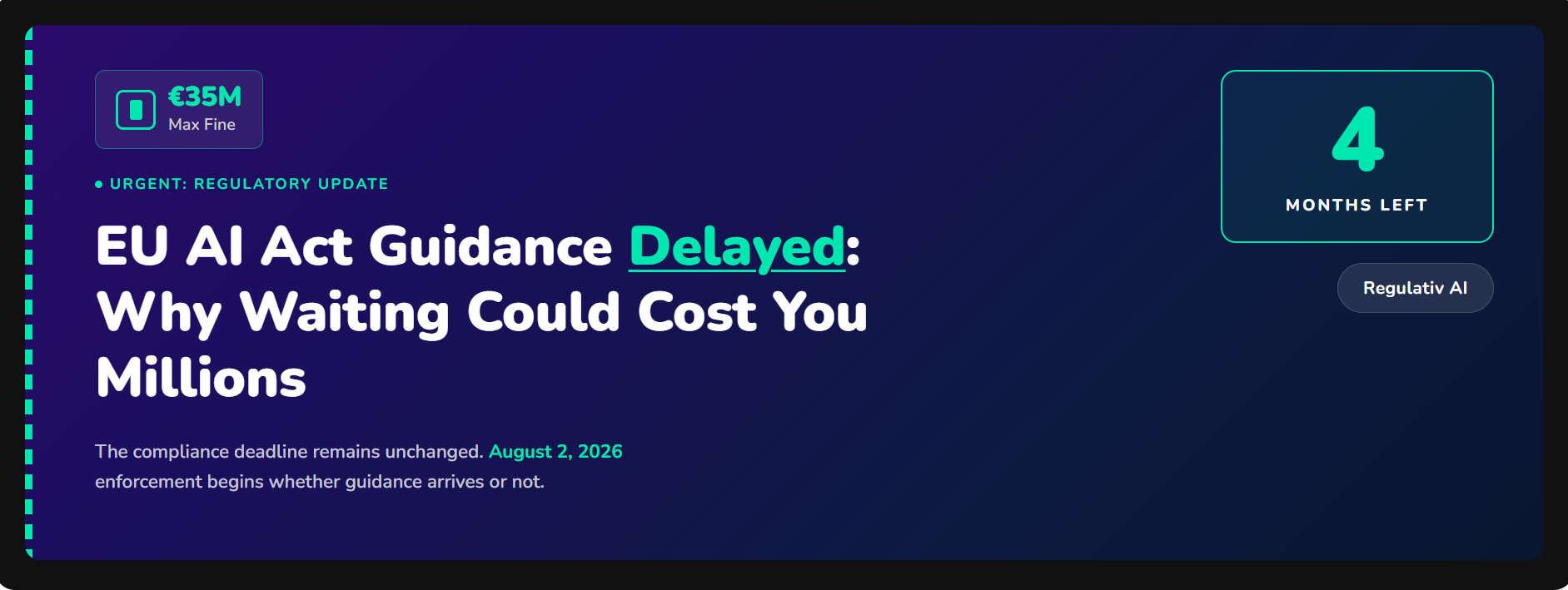
EU AI Act Guidance Delayed: Why Waiting Could Cost You Millions

The European Commission's recent announcement of delaying official guidance for the EU AI Act has sent shockwaves through the business community. While many companies are breathing a sigh of relief, treating this delay as extra preparation time, the reality is far more complex—and potentially costly.

If you're waiting for complete guidance before starting your EU AI Act compliance journey, you could be setting your organization up for millions in fines, competitive disadvantage, and operational chaos when enforcement begins. Here's why the guidance delay should accelerate your compliance efforts, not slow them down.

The Guidance Delay: What Actually Happened

The European Commission has postponed the release of comprehensive implementation guidance for the EU AI Act until late 2025, several months later than originally planned. This delay affects:

  • Technical documentation standards for high-risk AI systems
  • Conformity assessment procedures and certification requirements
  • Detailed risk management frameworks and testing protocols
  • Specific sector implementation guidelines for healthcare, finance, and other industries
  • Code of conduct templates for general-purpose AI systems

However—and this is crucial—the compliance deadlines remain unchanged. The EU AI Act's enforcement timeline is locked in, with key milestones beginning in 2025 and full enforcement by August 2026. This creates a dangerous gap: companies must comply with regulations before receiving complete official guidance on how to comply.

⚠️ Critical Insight

The guidance delay is NOT a compliance delay. Your obligations under the EU AI Act remain the same, regardless of when detailed guidance arrives.

📥 Download: EU AI Act Compliance Timeline & Checklist - Free resource showing exactly what you need to do and when, despite guidance delays.

The Million-Dollar Risk of Waiting

Understanding the Financial Stakes

The EU AI Act carries some of the steepest penalties in regulatory history. Non-compliance can result in:

  • €35 million or 7% of global annual turnover (whichever is higher) for prohibited AI practices
  • €15 million or 3% of global annual turnover for violations of AI Act obligations
  • €7.5 million or 1.5% of global annual turnover for supplying incorrect information

For context, if your company has €1 billion in annual revenue, a single violation could cost you €70 million. For larger enterprises with €10 billion revenue, we're talking about €700 million in potential fines.

Real-World Cost Scenarios

Let's break down what waiting could cost:

Scenario Timeline & Outcome Total Cost
Scenario 1: The Last-Minute Scramble • Company waits for complete guidance (arrives December 2025)
• Enforcement begins February 2026
• 2-3 months to implement comprehensive AI governance
Result: Incomplete compliance, violations detected
€20-30 million
Scenario 2: The GDPR Déjà Vu • €1.5 billion in fines in first two years
• Average fine of €4.3 million per violation
• 85% of fined companies claimed they "didn't have clear guidance"
€4.3M average
Scenario 3: The Competitive Disadvantage • Lost contracts requiring AI Act compliance
• Market access barriers in EU markets
• Investor concerns, valuation impacts
• Talent acquisition challenges
Unquantifiable

🎯 Start Your AI Compliance Assessment - Identify your risk level and compliance gaps in 10 minutes with Regulativ.ai's free assessment tool.

What IS Clear (Despite the Delay)

Here's the critical truth that most companies miss: approximately 70% of EU AI Act requirements are already well-defined. You don't need to wait for additional guidance to start—and complete—much of your compliance journey.

1. Risk Classification is Crystal Clear

The EU AI Act defines four risk categories with specific obligations for each:

Unacceptable Risk (Prohibited AI Systems) These AI systems are banned outright:

  • Social scoring by governments
  • Real-time biometric identification in public spaces (with limited exceptions)
  • AI exploiting vulnerabilities of specific groups
  • Subliminal manipulation techniques

High-Risk AI Systems These require comprehensive compliance including:

  • Risk management systems throughout the AI lifecycle
  • Data governance and quality requirements
  • Technical documentation and record-keeping
  • Transparency obligations to users
  • Human oversight measures
  • Accuracy, robustness, and cybersecurity standards

High-risk categories include AI used in:

  • Critical infrastructure management
  • Education and vocational training
  • Employment and worker management
  • Essential public and private services
  • Law enforcement
  • Migration and border control
  • Administration of justice

Limited Risk AI These have transparency obligations:

  • Disclosure when interacting with AI systems
  • Content labeling for AI-generated content
  • Transparency about AI use in decision-making

Minimal Risk AI These have voluntary compliance options with codes of conduct.

2. Core Compliance Obligations are Defined

Regardless of pending guidance, high-risk AI providers must implement:

Compliance Area Key Requirements
Risk Management System • Continuous risk identification and analysis
• Risk estimation and evaluation
• Risk mitigation measures
• Post-market monitoring
Data Governance Requirements • Training, validation, and testing data practices
• Data quality criteria
• Bias examination and mitigation
• Privacy-preserving measures
Technical Documentation • Detailed system descriptions
• Design specifications and methodology
• Development process documentation
• Performance metrics and testing results
Record-Keeping and Logging • Automatic logging capabilities
• Traceability throughout AI system lifecycle
• Event logging for high-risk systems
Transparency and User Information • Clear instructions for use
• Disclosure of AI capabilities and limitations
• Information about human oversight
Human Oversight Measures • Design features enabling human intervention
• Stop functionality or system reversal
• Monitoring for anomalies and system failures
Accuracy, Robustness, and Cybersecurity • Performance metrics and validation
• Resilience against errors and faults
• Security against third-party interference

3. Implementation Timeline is Set

Key EU AI Act milestones (unchanged by guidance delay):

Date Milestone Impact
February 2, 2025 Ban on prohibited AI practices takes effect Immediate enforcement
August 2, 2025 Rules on general-purpose AI models apply 6 months away
August 2, 2026 High-risk AI system requirements fully enforced 18 months to compliance
August 2, 2027 High-risk AI in products with existing EU safety legislation 30 months runway
    This means you have less than 18 months to achieve full compliance for high-risk systems.

📚 Access: Complete EU AI Act Implementation Guide - Step-by-step roadmap for AI compliance despite regulatory uncertainty.

Your 5-Step Action Plan (Start Today, Not Tomorrow)

Don't wait for guidance that may arrive too late. Here's your practical roadmap for EU AI Act compliance using existing frameworks and proven methodologies.

Step 1: AI System Inventory & Risk Classification (Week 1-2)

What to do:

  • Create a comprehensive inventory of ALL AI systems in your organization
  • Classify each system according to EU AI Act risk categories
  • Identify systems requiring immediate attention (high-risk and prohibited)
  • Map AI systems to business processes and data flows

How Regulativ.ai helps: Our AI Compliance Platform includes pre-built AI inventory templates aligned with EU AI Act classification criteria. Simply upload your system details, and our platform automatically classifies risk levels and flags compliance requirements.

Deliverable: Complete AI system register with risk classifications

Step 2: Gap Analysis Against Known Requirements (Week 2-4)

What to do:

  • Assess current AI governance practices against EU AI Act obligations
  • Identify gaps in documentation, risk management, and technical controls
  • Prioritize remediation activities based on risk and enforcement timeline
  • Estimate resources needed for full compliance

How Regulativ.ai helps: With 100+ built-in controls mapped to EU AI Act requirements, our platform automatically identifies your compliance gaps. Run automated assessments against Article 9 (risk management), Article 10 (data governance), and all other key provisions.

🔍 Try Free Gap Analysis - Upload your current AI documentation and receive an automated compliance score within minutes.

Deliverable: Prioritized compliance gap remediation roadmap

Step 3: Implement ISO 42001 as Your Foundation (Month 1-3)

What to do: ISO 42001 (Artificial Intelligence Management System) is the international standard specifically designed for AI governance. It aligns closely with EU AI Act requirements and provides the structural framework you need.

Key ISO 42001 components:

  • AI management system policies and procedures
  • Risk assessment methodology
  • Stakeholder requirements and expectations
  • Legal and regulatory requirements tracking
  • AI system lifecycle management
  • Continuous improvement processes

How Regulativ.ai helps: We offer complete ISO 42001 templates and workflows ready for deployment. Our platform manages the entire AI management system, from policy documentation to audit evidence collection. Many of our clients achieve ISO 42001 certification within 90 days using our automated framework.

Why this matters: ISO 42001 certification demonstrates AI governance maturity and can serve as evidence of EU AI Act compliance efforts. It's recognized globally and accepted by regulators as a legitimate compliance pathway.

Deliverable: Operational AI management system aligned with ISO 42001 and EU AI Act

Step 4: Build Documentation & Processes (Month 2-4)

What to do: Create the documentation infrastructure required by the EU AI Act:

Technical Documentation Package:

  • System design and architecture specifications
  • Training data characteristics and provenance
  • Algorithms and model descriptions
  • Performance metrics and validation results
  • Risk assessment documentation

Process Documentation:

  • Risk management procedures
  • Data governance policies and practices
  • Change management processes
  • Incident response and monitoring protocols
  • Human oversight mechanisms

Compliance Evidence:

  • Testing and validation records
  • Bias assessment and mitigation evidence
  • Security and robustness testing results
  • Ongoing monitoring logs

How Regulativ.ai helps: Our platform's automated documentation generator creates EU AI Act-compliant technical files based on your system inputs. We maintain version control, ensure completeness, and update documentation automatically as your AI systems evolve.

Plus, our AI-powered assistant helps you understand complex regulatory requirements and generates customized compliance narratives for your specific AI use cases.

⚡ See Demo: Automated Compliance Documentation - Watch how Regulativ.ai generates complete EU AI Act documentation in minutes, not months.

Deliverable: Complete technical documentation packages for all high-risk AI systems

Step 5: Continuous Monitoring & Adaptive Compliance (Ongoing)

What to do: The EU AI Act requires ongoing compliance, not one-time certification:

  • Monitor AI system performance continuously
  • Track regulatory developments and guidance updates
  • Update risk assessments as systems change
  • Maintain audit trails and evidence
  • Conduct periodic compliance reviews

How Regulativ.ai helps: Our platform provides:

  • Real-time regulatory change tracking: Automatic alerts when EU AI Act guidance or interpretations are published
  • Continuous compliance monitoring: Dashboard showing compliance status across all AI systems
  • Automated evidence collection: System automatically logs required information
  • Compliance calendar: Never miss a deadline or required review
  • Multi-regulation management: Simultaneously manage EU AI Act, ISO 42001, NIST AI RMF, and state-level regulations

Deliverable: Living compliance program that adapts to regulatory changes

The Automation Advantage: Why Manual Compliance Won't Work

The Challenge of Evolving Requirements

The EU AI Act guidance delay highlights a fundamental challenge: AI regulation is dynamic. Requirements evolve, interpretations change, and new guidance emerges continuously. Manual compliance approaches simply cannot keep pace.

Problems with spreadsheet-based compliance:

  • Version control nightmares when requirements change
  • Documentation gaps and inconsistencies
  • No audit trail of compliance activities
  • Inability to track changes across multiple AI systems
  • Time-intensive manual updates for every regulatory change
  • High risk of human error in complex mapping exercises

The Power of Automated Compliance

Regulativ.ai's AI Compliance Automation Platform addresses these challenges:

  • Pre-Built Templates: 100+ controls mapped to EU AI Act, ISO 42001, NIST AI RMF, Colorado AI Act, and NYC AI hiring law
  • Automatic Updates: When official EU AI Act guidance is released, our templates update automatically—your compliance stays current without manual work
  • Multi-Regulation Alignment: Manage all AI regulations from one platform, eliminating duplicate work
  • Complete Audit Trail: Every compliance activity is logged, timestamped, and documented for regulatory review
  • Workflow Automation: Evidence collection, document generation, and approval processes run automatically
  • AI-Powered Assistant: Get instant answers about EU AI Act requirements specific to your systems
  • Collaboration Platform: Coordinate compliance across legal, technical, and business teams seamlessly

Real Results from Regulativ.ai Clients

Company Profile Implementation Results
FinTech Company
150 employees, 12 AI systems
• Started: January 2025
• Full documentation compliance: March 2025
Timeline: 90 days
• 67% cost savings
• 6 months ahead of deadline
• 2 FTEs vs. 6 FTEs estimated
Healthcare AI Provider
AI-powered diagnostic tools
• Managing compliance across EU AI Act, FDA, HIPAA, and GDPR
• Unified compliance management
• 80% reduction in compliance overhead
• Simultaneous multi-framework certification
Enterprise Software Company
5,000+ employees, 40+ AI features
• Complete AI inventory and risk classification
Completed in 2 weeks
• Identified 8 high-risk systems
• 6 months before compliance deadline

Start Your Free Trial

Experience automated AI compliance with Regulativ.ai. No credit card required.

Get started now →

Beyond the EU: A Global AI Compliance Approach

While EU AI Act compliance is urgent, forward-thinking organizations recognize that AI regulation is accelerating globally. The guidance delay offers an opportunity to implement a compliance framework that addresses multiple jurisdictions simultaneously.

Regulatory Convergence

Regulativ.ai manages compliance across:

🇪🇺 EU AI Act

  • High-risk AI system requirements
  • Prohibited AI practices
  • Transparency obligations
  • Conformity assessments

🏢 ISO 42001

  • International AI management standard
  • Globally recognized certification
  • Foundation for multiple compliance regimes

🇺🇸 NIST AI Risk Management Framework

  • US federal AI standard
  • Voluntary but widely adopted
  • Required for government contractors

🏔️ Colorado SB21-169

  • First US state AI law
  • High-risk AI decision-making requirements
  • Template for other states

🗽 NYC Local Law No. 144

  • AI hiring tool bias audits
  • Annual bias audit requirements
  • Public disclosure obligations

Unified Approach Benefits:

  • Single documentation repository for all regulations
  • Shared controls reducing duplicate work
  • Consistent risk assessment methodology
  • Streamlined audit and certification processes
  • One platform to rule them all

📖 Learn More: Global AI Compliance Strategy - Discover how to manage multiple AI regulations efficiently with Regulativ.ai.

Common Myths About the Guidance Delay

Myth 1: "We Can Wait for Guidance Before Starting"

Reality: 70% of requirements are already clear. Companies starting now will have 18+ months to refine their approach as guidance emerges. Those waiting may have only 2-3 months between guidance release and enforcement.

Myth 2: "Guidance Will Change Everything We Know"

Reality: Guidance will clarify details and provide examples, but core obligations are locked in the legislation. Risk categories, documentation requirements, and fundamental principles won't change.

Myth 3: "We're Not Subject to EU AI Act (We're Based in the US/Asia)"

Reality: The EU AI Act has extraterritorial reach. If your AI systems are used in the EU, process EU residents' data, or make decisions affecting EU individuals, you're likely subject to compliance regardless of your headquarters location.

Myth 4: "Small Companies Are Exempt"

Reality: While some provisions include SME considerations, high-risk AI system requirements apply regardless of company size. A startup deploying AI in hiring or credit scoring has the same obligations as a Fortune 500 company.

Myth 5: "We Can Just Pull Our AI from the EU Market"

Reality: EU represents 450 million consumers and €15 trillion GDP. Most global companies cannot afford to forfeit this market. Additionally, other jurisdictions are adopting similar frameworks—exit isn't sustainable.

Taking Action Today: Your Immediate Next Steps

The EU AI Act guidance delay should be your catalyst for action, not your excuse for inaction. Here's what to do right now:

This Week:

  1. Conduct AI Inventory: List all AI systems in your organization
  1. Classify Risk Levels: Use EU AI Act criteria to categorize systems
  1. Assess Current State: Identify where you stand on key requirements
  1. Assign Responsibility: Designate an AI compliance owner or team

This Month:

  1. Choose Your Framework: Adopt ISO 42001 as your foundation
  1. Select Your Tools: Implement compliance automation platform (we recommend Regulativ.ai, naturally)
  1. Begin Documentation: Start creating technical files for high-risk systems
  1. Engage Stakeholders: Brief leadership on compliance requirements and timeline

This Quarter:

  1. Implement Risk Management: Deploy systematic risk assessment processes
  1. Establish Data Governance: Create policies for training data quality and bias mitigation
  1. Design Human Oversight: Build mechanisms for human intervention in AI decisions
  1. Create Monitoring Systems: Implement logging and performance tracking

This Year:

  1. Complete Technical Documentation: Finish all required documentation packages
  1. Conduct Internal Audits: Validate compliance before external assessment
  1. Train Your Team: Ensure everyone understands their role in AI compliance
  1. Prepare for Certification: Ready your organization for conformity assessment

Resources & Support

Free Resources from Regulativ.ai:

📥 EU AI Act Compliance Checklist Complete checklist of all requirements, organized by risk category and compliance deadline

📥 AI System Classification Template Spreadsheet for inventorying and classifying your AI systems according to EU AI Act criteria

📥 Gap Analysis Worksheet Self-assessment tool to identify your current compliance gaps

📥 ISO 42001 + EU AI Act Mapping Guide Document showing how ISO 42001 requirements align with EU AI Act obligations

Regulativ.ai Platform Features:

🤖 AI Compliance Automation: Manage EU AI Act, ISO 42001, NIST AI RMF, and state regulations from one platform

📚 100+ Built-in Templates: Pre-mapped controls and documentation templates for all major AI regulations

🔄 Automatic Regulatory Updates: Stay current as new guidance and interpretations emerge

📊 Real-Time Compliance Dashboard: Visual overview of compliance status across all AI systems

👥 Collaboration Tools: Coordinate compliance across legal, technical, and business teams

🔍 AI-Powered Assistant: Get instant answers to complex compliance questions

📝 Automated Documentation: Generate EU AI Act technical files automatically

🎯 Evidence Collection: Maintain complete audit trails without manual tracking

Conclusion: Turn Uncertainty into Competitive Advantage

The EU AI Act guidance delay is not a setback—it's an opportunity for strategic organizations to gain competitive advantage. While your competitors wait for perfect clarity that may never come, you can:

Build robust AI governance systems using existing frameworks ✅ Establish market leadership as a certified AI-compliant provider ✅ Avoid last-minute panic and rushed, expensive implementations ✅ Demonstrate trustworthiness to customers, investors, and regulators ✅ Position for global expansion with multi-jurisdiction compliance

The companies that succeed in the AI era won't be those with the most sophisticated models—they'll be those that deploy AI responsibly, compliantly, and at scale. Compliance is your competitive advantage, not your burden.

Don't let the guidance delay cost you millions in fines, lost opportunities, and competitive disadvantage. Start your EU AI Act compliance journey today.

!-- FINAL CTA BOX -->

🚀 Get Started with Regulativ.ai

Take control of your EU AI Act compliance journey with the leading AI compliance automation platform.

  • 📊 Free Compliance Assessment - Take the 10-minute assessment to understand your current AI compliance posture
  • 🎬 Schedule a Demo - Book a personalized demo to see how Regulativ.ai automates EU AI Act compliance
  • 📚 Explore AI Regulations - Learn about all supported regulations including EU AI Act, ISO 42001, NIST AI RMF, and more
  • 📖 Read More Guides - Access our complete AI governance library

About Regulativ.ai

Regulativ.ai is the leading AI Compliance Automation Platform, helping organizations worldwide navigate complex AI regulations including the EU AI Act, ISO 42001, NIST AI RMF, Colorado AI Act, and NYC Local Law 144. Our platform features 100+ built-in templates, automated documentation generation, and real-time regulatory tracking—enabling companies to achieve compliance 60-90% faster than manual approaches.

Join 100+ organizations using Regulativ.ai to simplify AI compliance and accelerate responsible AI deployment.

EU AI Act Guidance Delayed: Why Waiting Could Cost You Millions

The European Commission's recent announcement of delaying official guidance for the EU AI Act has sent shockwaves through the business community. While many companies are breathing a sigh of relief, treating this delay as extra preparation time, the reality is far more complex—and potentially costly.

If you're waiting for complete guidance before starting your EU AI Act compliance journey, you could be setting your organization up for millions in fines, competitive disadvantage, and operational chaos when enforcement begins. Here's why the guidance delay should accelerate your compliance efforts, not slow them down.

The Guidance Delay: What Actually Happened

The European Commission has postponed the release of comprehensive implementation guidance for the EU AI Act until late 2025, several months later than originally planned. This delay affects:

  • Technical documentation standards for high-risk AI systems
  • Conformity assessment procedures and certification requirements
  • Detailed risk management frameworks and testing protocols
  • Specific sector implementation guidelines for healthcare, finance, and other industries
  • Code of conduct templates for general-purpose AI systems

However—and this is crucial—the compliance deadlines remain unchanged. The EU AI Act's enforcement timeline is locked in, with key milestones beginning in 2025 and full enforcement by August 2026. This creates a dangerous gap: companies must comply with regulations before receiving complete official guidance on how to comply.

⚠️ Critical Insight

The guidance delay is NOT a compliance delay. Your obligations under the EU AI Act remain the same, regardless of when detailed guidance arrives.

📥 Download: EU AI Act Compliance Timeline & Checklist - Free resource showing exactly what you need to do and when, despite guidance delays.

The Million-Dollar Risk of Waiting

Understanding the Financial Stakes

The EU AI Act carries some of the steepest penalties in regulatory history. Non-compliance can result in:

  • €35 million or 7% of global annual turnover (whichever is higher) for prohibited AI practices
  • €15 million or 3% of global annual turnover for violations of AI Act obligations
  • €7.5 million or 1.5% of global annual turnover for supplying incorrect information

For context, if your company has €1 billion in annual revenue, a single violation could cost you €70 million. For larger enterprises with €10 billion revenue, we're talking about €700 million in potential fines.

Real-World Cost Scenarios

Let's break down what waiting could cost:

Scenario Timeline & Outcome Total Cost
Scenario 1: The Last-Minute Scramble • Company waits for complete guidance (arrives December 2025)
• Enforcement begins February 2026
• 2-3 months to implement comprehensive AI governance
Result: Incomplete compliance, violations detected
€20-30 million
Scenario 2: The GDPR Déjà Vu • €1.5 billion in fines in first two years
• Average fine of €4.3 million per violation
• 85% of fined companies claimed they "didn't have clear guidance"
€4.3M average
Scenario 3: The Competitive Disadvantage • Lost contracts requiring AI Act compliance
• Market access barriers in EU markets
• Investor concerns, valuation impacts
• Talent acquisition challenges
Unquantifiable

🎯 Start Your AI Compliance Assessment - Identify your risk level and compliance gaps in 10 minutes with Regulativ.ai's free assessment tool.

What IS Clear (Despite the Delay)

Here's the critical truth that most companies miss: approximately 70% of EU AI Act requirements are already well-defined. You don't need to wait for additional guidance to start—and complete—much of your compliance journey.

1. Risk Classification is Crystal Clear

The EU AI Act defines four risk categories with specific obligations for each:

Unacceptable Risk (Prohibited AI Systems) These AI systems are banned outright:

  • Social scoring by governments
  • Real-time biometric identification in public spaces (with limited exceptions)
  • AI exploiting vulnerabilities of specific groups
  • Subliminal manipulation techniques

High-Risk AI Systems These require comprehensive compliance including:

  • Risk management systems throughout the AI lifecycle
  • Data governance and quality requirements
  • Technical documentation and record-keeping
  • Transparency obligations to users
  • Human oversight measures
  • Accuracy, robustness, and cybersecurity standards

High-risk categories include AI used in:

  • Critical infrastructure management
  • Education and vocational training
  • Employment and worker management
  • Essential public and private services
  • Law enforcement
  • Migration and border control
  • Administration of justice

Limited Risk AI These have transparency obligations:

  • Disclosure when interacting with AI systems
  • Content labeling for AI-generated content
  • Transparency about AI use in decision-making

Minimal Risk AI These have voluntary compliance options with codes of conduct.

2. Core Compliance Obligations are Defined

Regardless of pending guidance, high-risk AI providers must implement:

Compliance Area Key Requirements
Risk Management System • Continuous risk identification and analysis
• Risk estimation and evaluation
• Risk mitigation measures
• Post-market monitoring
Data Governance Requirements • Training, validation, and testing data practices
• Data quality criteria
• Bias examination and mitigation
• Privacy-preserving measures
Technical Documentation • Detailed system descriptions
• Design specifications and methodology
• Development process documentation
• Performance metrics and testing results
Record-Keeping and Logging • Automatic logging capabilities
• Traceability throughout AI system lifecycle
• Event logging for high-risk systems
Transparency and User Information • Clear instructions for use
• Disclosure of AI capabilities and limitations
• Information about human oversight
Human Oversight Measures • Design features enabling human intervention
• Stop functionality or system reversal
• Monitoring for anomalies and system failures
Accuracy, Robustness, and Cybersecurity • Performance metrics and validation
• Resilience against errors and faults
• Security against third-party interference

3. Implementation Timeline is Set

Key EU AI Act milestones (unchanged by guidance delay):

Date Milestone Impact
February 2, 2025 Ban on prohibited AI practices takes effect Immediate enforcement
August 2, 2025 Rules on general-purpose AI models apply 6 months away
August 2, 2026 High-risk AI system requirements fully enforced 18 months to compliance
August 2, 2027 High-risk AI in products with existing EU safety legislation 30 months runway
    This means you have less than 18 months to achieve full compliance for high-risk systems.

📚 Access: Complete EU AI Act Implementation Guide - Step-by-step roadmap for AI compliance despite regulatory uncertainty.

Your 5-Step Action Plan (Start Today, Not Tomorrow)

Don't wait for guidance that may arrive too late. Here's your practical roadmap for EU AI Act compliance using existing frameworks and proven methodologies.

Step 1: AI System Inventory & Risk Classification (Week 1-2)

What to do:

  • Create a comprehensive inventory of ALL AI systems in your organization
  • Classify each system according to EU AI Act risk categories
  • Identify systems requiring immediate attention (high-risk and prohibited)
  • Map AI systems to business processes and data flows

How Regulativ.ai helps: Our AI Compliance Platform includes pre-built AI inventory templates aligned with EU AI Act classification criteria. Simply upload your system details, and our platform automatically classifies risk levels and flags compliance requirements.

Deliverable: Complete AI system register with risk classifications

Step 2: Gap Analysis Against Known Requirements (Week 2-4)

What to do:

  • Assess current AI governance practices against EU AI Act obligations
  • Identify gaps in documentation, risk management, and technical controls
  • Prioritize remediation activities based on risk and enforcement timeline
  • Estimate resources needed for full compliance

How Regulativ.ai helps: With 100+ built-in controls mapped to EU AI Act requirements, our platform automatically identifies your compliance gaps. Run automated assessments against Article 9 (risk management), Article 10 (data governance), and all other key provisions.

🔍 Try Free Gap Analysis - Upload your current AI documentation and receive an automated compliance score within minutes.

Deliverable: Prioritized compliance gap remediation roadmap

Step 3: Implement ISO 42001 as Your Foundation (Month 1-3)

What to do: ISO 42001 (Artificial Intelligence Management System) is the international standard specifically designed for AI governance. It aligns closely with EU AI Act requirements and provides the structural framework you need.

Key ISO 42001 components:

  • AI management system policies and procedures
  • Risk assessment methodology
  • Stakeholder requirements and expectations
  • Legal and regulatory requirements tracking
  • AI system lifecycle management
  • Continuous improvement processes

How Regulativ.ai helps: We offer complete ISO 42001 templates and workflows ready for deployment. Our platform manages the entire AI management system, from policy documentation to audit evidence collection. Many of our clients achieve ISO 42001 certification within 90 days using our automated framework.

Why this matters: ISO 42001 certification demonstrates AI governance maturity and can serve as evidence of EU AI Act compliance efforts. It's recognized globally and accepted by regulators as a legitimate compliance pathway.

Deliverable: Operational AI management system aligned with ISO 42001 and EU AI Act

Step 4: Build Documentation & Processes (Month 2-4)

What to do: Create the documentation infrastructure required by the EU AI Act:

Technical Documentation Package:

  • System design and architecture specifications
  • Training data characteristics and provenance
  • Algorithms and model descriptions
  • Performance metrics and validation results
  • Risk assessment documentation

Process Documentation:

  • Risk management procedures
  • Data governance policies and practices
  • Change management processes
  • Incident response and monitoring protocols
  • Human oversight mechanisms

Compliance Evidence:

  • Testing and validation records
  • Bias assessment and mitigation evidence
  • Security and robustness testing results
  • Ongoing monitoring logs

How Regulativ.ai helps: Our platform's automated documentation generator creates EU AI Act-compliant technical files based on your system inputs. We maintain version control, ensure completeness, and update documentation automatically as your AI systems evolve.

Plus, our AI-powered assistant helps you understand complex regulatory requirements and generates customized compliance narratives for your specific AI use cases.

⚡ See Demo: Automated Compliance Documentation - Watch how Regulativ.ai generates complete EU AI Act documentation in minutes, not months.

Deliverable: Complete technical documentation packages for all high-risk AI systems

Step 5: Continuous Monitoring & Adaptive Compliance (Ongoing)

What to do: The EU AI Act requires ongoing compliance, not one-time certification:

  • Monitor AI system performance continuously
  • Track regulatory developments and guidance updates
  • Update risk assessments as systems change
  • Maintain audit trails and evidence
  • Conduct periodic compliance reviews

How Regulativ.ai helps: Our platform provides:

  • Real-time regulatory change tracking: Automatic alerts when EU AI Act guidance or interpretations are published
  • Continuous compliance monitoring: Dashboard showing compliance status across all AI systems
  • Automated evidence collection: System automatically logs required information
  • Compliance calendar: Never miss a deadline or required review
  • Multi-regulation management: Simultaneously manage EU AI Act, ISO 42001, NIST AI RMF, and state-level regulations

Deliverable: Living compliance program that adapts to regulatory changes

The Automation Advantage: Why Manual Compliance Won't Work

The Challenge of Evolving Requirements

The EU AI Act guidance delay highlights a fundamental challenge: AI regulation is dynamic. Requirements evolve, interpretations change, and new guidance emerges continuously. Manual compliance approaches simply cannot keep pace.

Problems with spreadsheet-based compliance:

  • Version control nightmares when requirements change
  • Documentation gaps and inconsistencies
  • No audit trail of compliance activities
  • Inability to track changes across multiple AI systems
  • Time-intensive manual updates for every regulatory change
  • High risk of human error in complex mapping exercises

The Power of Automated Compliance

Regulativ.ai's AI Compliance Automation Platform addresses these challenges:

  • Pre-Built Templates: 100+ controls mapped to EU AI Act, ISO 42001, NIST AI RMF, Colorado AI Act, and NYC AI hiring law
  • Automatic Updates: When official EU AI Act guidance is released, our templates update automatically—your compliance stays current without manual work
  • Multi-Regulation Alignment: Manage all AI regulations from one platform, eliminating duplicate work
  • Complete Audit Trail: Every compliance activity is logged, timestamped, and documented for regulatory review
  • Workflow Automation: Evidence collection, document generation, and approval processes run automatically
  • AI-Powered Assistant: Get instant answers about EU AI Act requirements specific to your systems
  • Collaboration Platform: Coordinate compliance across legal, technical, and business teams seamlessly

Real Results from Regulativ.ai Clients

Company Profile Implementation Results
FinTech Company
150 employees, 12 AI systems
• Started: January 2025
• Full documentation compliance: March 2025
Timeline: 90 days
• 67% cost savings
• 6 months ahead of deadline
• 2 FTEs vs. 6 FTEs estimated
Healthcare AI Provider
AI-powered diagnostic tools
• Managing compliance across EU AI Act, FDA, HIPAA, and GDPR
• Unified compliance management
• 80% reduction in compliance overhead
• Simultaneous multi-framework certification
Enterprise Software Company
5,000+ employees, 40+ AI features
• Complete AI inventory and risk classification
Completed in 2 weeks
• Identified 8 high-risk systems
• 6 months before compliance deadline

Start Your Free Trial

Experience automated AI compliance with Regulativ.ai. No credit card required.

Get started now →

Beyond the EU: A Global AI Compliance Approach

While EU AI Act compliance is urgent, forward-thinking organizations recognize that AI regulation is accelerating globally. The guidance delay offers an opportunity to implement a compliance framework that addresses multiple jurisdictions simultaneously.

Regulatory Convergence

Regulativ.ai manages compliance across:

🇪🇺 EU AI Act

  • High-risk AI system requirements
  • Prohibited AI practices
  • Transparency obligations
  • Conformity assessments

🏢 ISO 42001

  • International AI management standard
  • Globally recognized certification
  • Foundation for multiple compliance regimes

🇺🇸 NIST AI Risk Management Framework

  • US federal AI standard
  • Voluntary but widely adopted
  • Required for government contractors

🏔️ Colorado SB21-169

  • First US state AI law
  • High-risk AI decision-making requirements
  • Template for other states

🗽 NYC Local Law No. 144

  • AI hiring tool bias audits
  • Annual bias audit requirements
  • Public disclosure obligations

Unified Approach Benefits:

  • Single documentation repository for all regulations
  • Shared controls reducing duplicate work
  • Consistent risk assessment methodology
  • Streamlined audit and certification processes
  • One platform to rule them all

📖 Learn More: Global AI Compliance Strategy - Discover how to manage multiple AI regulations efficiently with Regulativ.ai.

Common Myths About the Guidance Delay

Myth 1: "We Can Wait for Guidance Before Starting"

Reality: 70% of requirements are already clear. Companies starting now will have 18+ months to refine their approach as guidance emerges. Those waiting may have only 2-3 months between guidance release and enforcement.

Myth 2: "Guidance Will Change Everything We Know"

Reality: Guidance will clarify details and provide examples, but core obligations are locked in the legislation. Risk categories, documentation requirements, and fundamental principles won't change.

Myth 3: "We're Not Subject to EU AI Act (We're Based in the US/Asia)"

Reality: The EU AI Act has extraterritorial reach. If your AI systems are used in the EU, process EU residents' data, or make decisions affecting EU individuals, you're likely subject to compliance regardless of your headquarters location.

Myth 4: "Small Companies Are Exempt"

Reality: While some provisions include SME considerations, high-risk AI system requirements apply regardless of company size. A startup deploying AI in hiring or credit scoring has the same obligations as a Fortune 500 company.

Myth 5: "We Can Just Pull Our AI from the EU Market"

Reality: EU represents 450 million consumers and €15 trillion GDP. Most global companies cannot afford to forfeit this market. Additionally, other jurisdictions are adopting similar frameworks—exit isn't sustainable.

Taking Action Today: Your Immediate Next Steps

The EU AI Act guidance delay should be your catalyst for action, not your excuse for inaction. Here's what to do right now:

This Week:

  1. Conduct AI Inventory: List all AI systems in your organization
  1. Classify Risk Levels: Use EU AI Act criteria to categorize systems
  1. Assess Current State: Identify where you stand on key requirements
  1. Assign Responsibility: Designate an AI compliance owner or team

This Month:

  1. Choose Your Framework: Adopt ISO 42001 as your foundation
  1. Select Your Tools: Implement compliance automation platform (we recommend Regulativ.ai, naturally)
  1. Begin Documentation: Start creating technical files for high-risk systems
  1. Engage Stakeholders: Brief leadership on compliance requirements and timeline

This Quarter:

  1. Implement Risk Management: Deploy systematic risk assessment processes
  1. Establish Data Governance: Create policies for training data quality and bias mitigation
  1. Design Human Oversight: Build mechanisms for human intervention in AI decisions
  1. Create Monitoring Systems: Implement logging and performance tracking

This Year:

  1. Complete Technical Documentation: Finish all required documentation packages
  1. Conduct Internal Audits: Validate compliance before external assessment
  1. Train Your Team: Ensure everyone understands their role in AI compliance
  1. Prepare for Certification: Ready your organization for conformity assessment

Resources & Support

Free Resources from Regulativ.ai:

📥 EU AI Act Compliance Checklist Complete checklist of all requirements, organized by risk category and compliance deadline

📥 AI System Classification Template Spreadsheet for inventorying and classifying your AI systems according to EU AI Act criteria

📥 Gap Analysis Worksheet Self-assessment tool to identify your current compliance gaps

📥 ISO 42001 + EU AI Act Mapping Guide Document showing how ISO 42001 requirements align with EU AI Act obligations

Regulativ.ai Platform Features:

🤖 AI Compliance Automation: Manage EU AI Act, ISO 42001, NIST AI RMF, and state regulations from one platform

📚 100+ Built-in Templates: Pre-mapped controls and documentation templates for all major AI regulations

🔄 Automatic Regulatory Updates: Stay current as new guidance and interpretations emerge

📊 Real-Time Compliance Dashboard: Visual overview of compliance status across all AI systems

👥 Collaboration Tools: Coordinate compliance across legal, technical, and business teams

🔍 AI-Powered Assistant: Get instant answers to complex compliance questions

📝 Automated Documentation: Generate EU AI Act technical files automatically

🎯 Evidence Collection: Maintain complete audit trails without manual tracking

Conclusion: Turn Uncertainty into Competitive Advantage

The EU AI Act guidance delay is not a setback—it's an opportunity for strategic organizations to gain competitive advantage. While your competitors wait for perfect clarity that may never come, you can:

Build robust AI governance systems using existing frameworks ✅ Establish market leadership as a certified AI-compliant provider ✅ Avoid last-minute panic and rushed, expensive implementations ✅ Demonstrate trustworthiness to customers, investors, and regulators ✅ Position for global expansion with multi-jurisdiction compliance

The companies that succeed in the AI era won't be those with the most sophisticated models—they'll be those that deploy AI responsibly, compliantly, and at scale. Compliance is your competitive advantage, not your burden.

Don't let the guidance delay cost you millions in fines, lost opportunities, and competitive disadvantage. Start your EU AI Act compliance journey today.

!-- FINAL CTA BOX -->

🚀 Get Started with Regulativ.ai

Take control of your EU AI Act compliance journey with the leading AI compliance automation platform.

  • 📊 Free Compliance Assessment - Take the 10-minute assessment to understand your current AI compliance posture
  • 🎬 Schedule a Demo - Book a personalized demo to see how Regulativ.ai automates EU AI Act compliance
  • 📚 Explore AI Regulations - Learn about all supported regulations including EU AI Act, ISO 42001, NIST AI RMF, and more
  • 📖 Read More Guides - Access our complete AI governance library

About Regulativ.ai

Regulativ.ai is the leading AI Compliance Automation Platform, helping organizations worldwide navigate complex AI regulations including the EU AI Act, ISO 42001, NIST AI RMF, Colorado AI Act, and NYC Local Law 144. Our platform features 100+ built-in templates, automated documentation generation, and real-time regulatory tracking—enabling companies to achieve compliance 60-90% faster than manual approaches.

Join 100+ organizations using Regulativ.ai to simplify AI compliance and accelerate responsible AI deployment.

heading 3

heading 4

The rich text element allows you to create and format headings, paragraphs, blockquotes, images, and video all in one place instead of having to add and format them individually. Just double-click and easily create content.

  • Establish a baseline across all business-critical capabilities
  • Conduct a thorough assessment of operations to establish benchmarks and set target maturity levels
CyberTech100 2021 logo with red, black, and gray circular arcs and website URL www.CyberTech100.com below.